
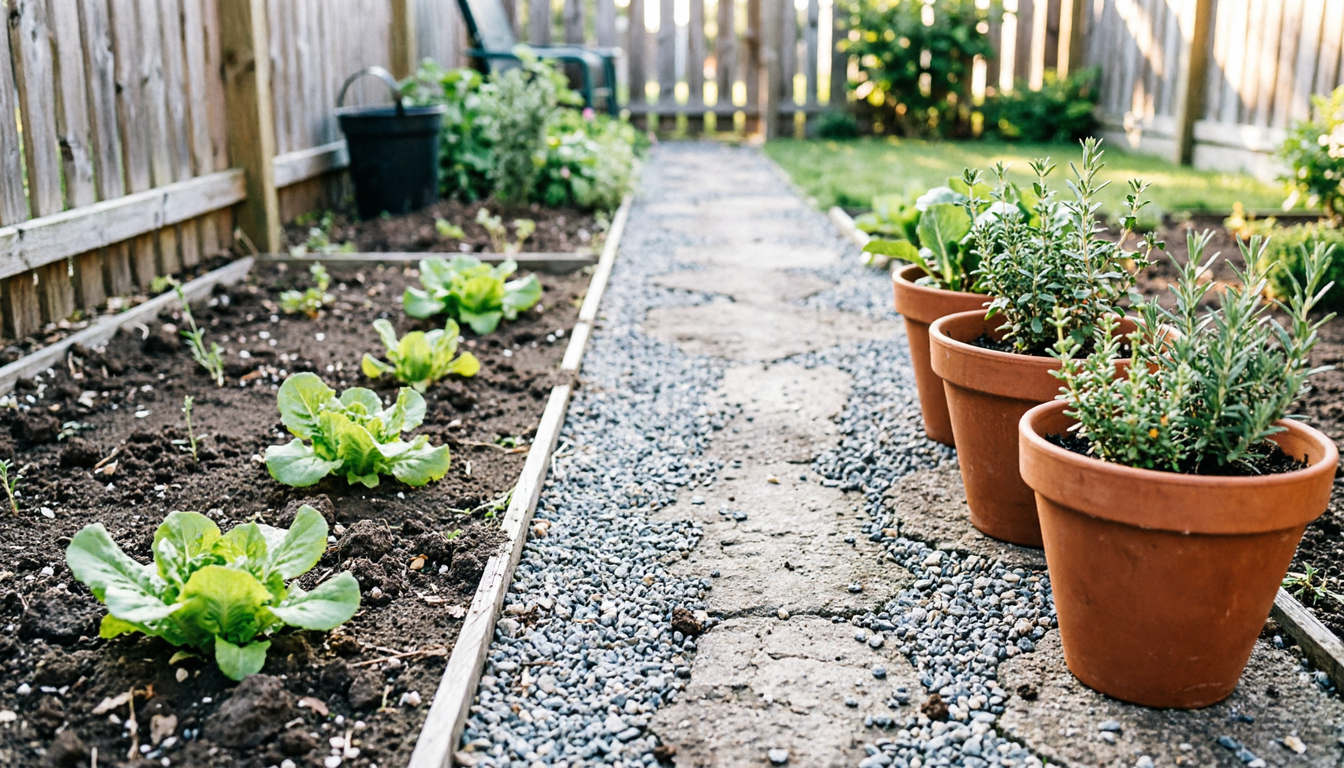
An 8-square-foot lettuce plot can fit in a small yard. Give it a separate 2-foot path on every side, though, and the space you mark out becomes 48 square feet. Pots need less digging, but buying containers, growing mix and watering tools can cost more than planting suitable soil you already have.
Start by checking what you can reuse. In the seasonal examples below, three suitable owned containers cost $44.18 to equip and run for the first year. Buying the bags, saucers and tools raises that budget to $126.61. A new small framed bed reaches $194.45. These budgets cover the stated sites and include allowances for small purchases, before tax, delivery and postage.
Choose the space before the shopping basket
Scroll sideways to compare columns. Keyboard users can focus the table and use the Left and Right arrow keys.
| Your available space | Sensible first choice | When to keep buying food instead |
|---|---|---|
| A windowsill | Try an existing suitable pot only if the crop, light and drainage fit | The sill is shallow, shaded, unstable or needs new lighting to make the crop possible |
| A permitted balcony or paved area | A few containers with reachable drainage | Permission, safe support or a way to contain runoff is unresolved |
| A sunny yard with suitable existing soil | A small in-ground plot | Testing or site history shows a problem that needs specialist advice or costly work |
| A ground-level paved area where a frame solves a real problem | A small bed, after pricing all the fill | The frame consumes the budget without making gardening easier or more practical |
A small garden can put leaves close to the kitchen. It will not replace a household’s whole food supply. Buying ordinary store vegetables, including frozen vegetables where they suit the meal, remains a valid choice.
A windowsill can be a no-buy decision
For leaf lettuce, University of Maryland Extension gives a half-gallon minimum container volume. Measure the pot too: volume does not tell you whether its base fits your sill. UMD’s general outdoor guidance is 3–5 hours of direct sun for cool-season crops, compared with 6–8 hours for warm-season crops such as peppers and tomatoes.[1] The Salad Bowl Blend used here specifies full sun.[4]
If your window does not provide the selected crop’s light, do not buy this lettuce setup for winter grocery savings. Nor does an outdoor sun figure establish adequate light through your particular window. Use a suitable pot you already own for a small trial, or wait for an outdoor spring location. A new shelf, grow light and electricity bill belong in a separate indoor budget. Our indoor garden running-cost guide covers those expenses.
Check the fully supported pot base, mature leaves, opening window and your access to the saucer. A narrow ledge with a large pot hanging over its edge fails that check even if the pot holds enough mix.
Count the planting area and the space you use
The layouts below use separate 2-foot paths on all sides so their arithmetic is comparable. These are planning choices, not wheelchair-clearance standards or minimum balcony sizes. Share paths where practical, widen them where needed, and check your reach without stepping into the soil.
Scroll sideways to compare columns. Keyboard users can focus the table and use the Left and Right arrow keys.
| Layout | Planting or equipment footprint | With the illustrative paths |
|---|---|---|
| In-ground lettuce plot | 2 × 4 feet of planted soil: 8 square feet | 6 × 8 feet: 48 square feet |
| Owned bed with a 2 × 4-foot planting interior | Same planted area; measure the frame outside it | More than the plot’s 48 square feet if the frame projects beyond the interior |
| Three nominal 5-gallon bags | Three listed 10-inch diameters, with 2-inch gaps: a 34 × 10-inch base rectangle | About 33.03 square feet before saucers or overhanging leaves |
| Those bags on the priced saucers | Three 13.5-inch outside diameters, with 2-inch gaps: 44.5 × 13.5 inches | About 39.51 square feet |
| Purchased 40 × 40-inch bed | Seller’s nominal bed area: about 11.11 square feet | About 53.78 square feet, subject to the actual outside frame dimensions |
Bootstrap Farmer lists its nominal 5-gallon bags as 12 inches high and 10 inches in diameter.[5] SUNPACK lists the selected 12-inch saucer with a 13.5-inch outside top diameter.[20] Check the filled bag and the saucer’s base before buying; flexible sides can bulge. Leave extra space wherever leaves extend beyond the equipment.
A larger bed makes the access cost easy to miss: a 4 × 8-foot outside frame with the same paths occupies 96 square feet. Its 32-square-foot outside rectangle is not all planted soil. Wall thickness reduces the interior.
Give the lettuce its mature spacing
For the 24 × 48-inch plot, use two rows along the long side, centered 6 and 18 inches across. Put six sowing groups in each row, at 4, 12, 20, 28, 36 and 44 inches along its length. Those margins are layout assumptions.
Botanical Interests specifies groups of three seeds every 8 inches, rows 12 inches apart, then thinning to one plant every 8 inches when seedlings are half an inch tall.[4] This layout starts with 36 seeds and aims for 12 plants after thinning. Put one intended plant in each of the three bags. Neither arrangement establishes a harvest weight.
The blend is listed as under 12 inches tall, with 21–50 days to maturity.[4] A seedling that fits today still needs its thinned spacing and room for leaves. For individual-leaf harvesting, the seller says to leave at least half the plant for regrowth; its alternative cut-and-regrow method leaves a 2-inch height.[4]
For the purchased square bed, first check that its clear interior accommodates a 36 × 36-inch planting square. Within that square, three rows 12 inches apart and four plants 8 inches apart per row fit with margins. This also gives 12 intended positions; the model assigns no extra harvest to the larger advertised area.
Soil and fill decide much of the bill
For an existing garden with intact topsoil, good drainage and no compaction, UMD describes adding 2–4 inches of compost and mixing it into the top 4 inches of soil.[3] On the 8-square-foot plot, that is about 1.33–2.67 cubic feet of compost. The lower-depth example needs one 1.5-cubic-foot bag; the higher one needs two. This is initial preparation, not an instruction to add that layer every year.
Have existing soil tested, including a lead screen, before treating it as suitable for food growing.[2][3] The University of Delaware’s posted B3 package includes fertility analysis, Estimated Total Lead and recommendations for $22.50. Its fee schedule is marked 2024 and was still posted on October 15, 2026. It covers Maryland soils; confirm the fee before ordering.[9] The budget assumes collected kit supplies. A mailed kit adds $5, and return postage is separate.[9] This screen is not clearance for every possible contaminant.
For beds on a hard surface, UMD specifies at least 8 inches of depth for leafy greens and a 1:1 mix of compost and soilless growing mix. It also warns about rapid drying and heat stress.[3]
- An owned bed with a measured 2 × 4-foot interior and an 8-inch fill needs about 5.33 cubic feet: 2.67 of each ingredient. Buy two 1.5-cubic-foot compost bags and two 2-cubic-foot mix bags. Measure equal volumes into the bed. About 0.33 cubic feet of compost and 1.33 cubic feet of mix remain before settlement adjustments.
- For the purchased bed, use its nominal 40 × 40-inch area as a conservative fill rectangle at 8 inches deep. That gives about 7.41 cubic feet, or 3.70 of each ingredient: three compost bags and two mix bags. The merchant lists a 10.5-inch bed depth.[19] Measure the actual interior and follow its assembly instructions; do not force the budgeted material into the frame.
- For the three bags, the seller estimates 0.66 cubic feet of fill each, or 1.98 together.[5] One 2-cubic-foot mix bag covers that estimate. However, a perfect cylinder using its listed dimensions holds only about 0.55 cubic feet. Merchant-hosted buyers also dispute the nominal capacity.[5] Treat the fill and dimensions as planning figures until you see the bags.
The bed examples use existing, level, ground-level paving with a safe drainage route and a surface where wet marks are acceptable. They do not cover a balcony, timber deck, contaminated site, new paving, excavation or a sealed-bottom planter. If the location needs that work, get its cost before choosing a bed. A cheap frame does not fix an unsuitable site.
The first-year shopping and running budget
These are US dollar offers observed on October 15, 2026, with no submitted delivery location or checked checkout. No member discount is used. Tax, delivery, sample postage and any special collection trip are excluded. The compost offer is local pickup or delivery from Unity Church Hill Nursery in Maryland; delivery needs a separate arrangement.[8] Use a supplier you can reach without an expensive trip.
Scroll sideways to compare columns. Keyboard users can focus the table and use the Left and Right arrow keys.
| Item and exact package | Price used |
|---|---|
| Botanical Interests Salad Bowl Blend, Organic Heirloom, approximately 0.75 g | $3.49 [4] |
| Bootstrap Farmer black nominal 5-gallon grow bags, ten-pack | $34.99 [5] |
| Espoma Organic Potting Mix, one 2-cubic-foot bag | $19.99 [6] |
| Same mix, one 1-cubic-foot bag for later renewal | $12.99 [6] |
| Leaf Gro compost, one 1.5-cubic-foot bag | $7.95 [8] |
| Espoma Garden-tone, one 4-pound bag | $7.69 [15] |
| Gardener Select 12.5-inch hand trowel | $6.49 [16] |
| Dramm 2-liter can with angled sprinkler head | $18.45 [17] |
| Radius Garden Root Slayer Nomad digging tool | $44.99 [18] |
| Backyard Expressions 40-inch corrugated bed, blue | $61.49 [19] |
| SUNPACK 12-inch black saucers, ten-pack | $22.50 [20] |
The new-container budget buys ten bags and ten saucers but uses three of each. It does not buy soil for the spares. The can and bed listings showed low stock; that is not a reservation or a local availability promise.[17][19] These are purchase examples, not a claim to have found the cheapest tools.
All six budgets include one seed packet, $10.01 for water and a $3 household allowance for cleaning supplies and small consumables during one spring crop period. They also include the first purchase of a $7.69 fertilizer pack as stored supplies. The new-frame route adds a $20 allowance for assembly tools, gloves or small hardware. Those two allowances are budget assumptions, not retailer quotes. Check the actual assembly list and replace the allowance with the amount you will spend.
Scroll sideways to compare columns. Keyboard users can focus the table and use the Left and Right arrow keys.
| Starting point | Initial setup and fertilizer stock | First crop-period running cost | First-year cash budget |
|---|---|---|---|
| Three suitable owned containers; tools and drainage already available | $27.68 | $16.50 | $44.18 |
| Buy bag pack, saucer pack, can and trowel | $110.11 | $16.50 | $126.61 |
| Suitable existing 2 × 4-foot soil plot; spade and can owned | $38.14 | $16.50 | $54.64 |
| Same plot; buy the digging tool and can | $101.58 | $16.50 | $118.08 |
| Owned suitable 2 × 4-foot interior frame; tools owned | $63.57 | $16.50 | $80.07 |
| Buy the 40-inch frame, fill, can and trowel; include assembly allowance | $177.95 | $16.50 | $194.45 |
The soil rows include the $22.50 test and one compost bag. They apply only when the soil result requires no additional purchased amendments beyond the included supplies. A second compost bag adds $7.95. The lettuce layouts need no climbing supports, and these examples use hand watering: no pump, irrigation kit, grow light or electricity purchase. Existing paths need no new covering. Household scissors, measuring tools and suitable storage are assumed owned; replace any missing-item allowance with its actual cost.
Water costs more than the water-only rate
The example is a WSSC residential customer in Maryland already paying normal household service charges. WSSC’s rates effective July 1, 2026 list $8.68 for water plus $11.34 for sewer per 1,000 gallons in the 81–165.9999 gallons-per-day band: $20.02 combined.[12] Outdoor use does not automatically escape the sewer charge; WSSC describes a separate submeter route for that adjustment.[13]
At an assumed household baseline of 120 gallons a day over a 90-day bill, adding 100, 500 or 1,000 gallons stays within that band. The added charges are $2.00, $10.01 or $20.02. These volumes are sensitivity inputs, not irrigation advice. Include watering, washing and cleanup in your own added volume. Fixed charges are excluded only because this household already pays them without the garden. If the garden changes your billing band, recalculate the household bill rather than applying this rate blindly.
Buy fertilizer once, then track what remains
The potting mix already contains nutrient ingredients, including earthworm castings and meals.[6] Buying Garden-tone is a provision for feeding, not an instruction to add the whole bag or double-feed fresh mix. UMD says to follow the fertilizer label and avoid overapplication. For mix containing 50% compost, it advises reducing fertilizer by half and waiting until plants are growing.[1]
Garden-tone’s established-pot instruction is 1.5 teaspoons per 4 inches of pot diameter.[14] At a measured 10-inch diameter, that works out to 3.75 teaspoons per pot, or 11.25 teaspoons across three pots for one application. That is a dose illustration, not a feeding calendar for this amended mix. Follow the appropriate label instructions and crop or soil advice. Keep fertilizer off stems and foliage.[14]
Plan one season, then price the next
This comparison budgets one 12-week spring growing period in Maryland, roughly April to mid-June, with no harvest credited outside it. UMD describes a broader March-to-December leaf-lettuce window with a July–August break; planting dates, heat and frost still affect individual gardens.[7] In October, use this example to plan for next spring rather than expecting a full spring harvest before winter. Later-year comparisons hold prices constant so you can see the effect of reuse; update them before spending.
Lettuce tolerates light frost but needs protection against heavy frost or freezing.[7] These budgets buy no frost cover and claim no protected winter harvest. Delay planting, finish the crop or add the actual protection cost when local conditions require it. Allow a zero-harvest establishment period, and reduce the harvest period after failed sowings. The seed packet’s maturity range is not a guaranteed first picking date.
Scroll sideways to compare columns. Keyboard users can focus the table and use the Left and Right arrow keys.
| Later-year purchase scenario, with sound equipment retained | Cash cost for one crop period | What changes from year one |
|---|---|---|
| Either container route | $29.49 | Seed, water, $3 consumables allowance and one 1-cubic-foot bag of fresh mix |
| Either existing-soil route | $39.00 | Seed, water, allowance and another $22.50 soil test; no other amendment required in this scenario |
| Either bed route | $37.44 | Seed, water, allowance, one 1-cubic-foot mix bag and one compost bag for a year when retained supplies do not cover the top-up |
UMD recommends refreshing reused container media with equal amounts of fresh growing media and/or compost, and discarding media affected by root disease.[1] The container calculation retains one cubic foot of suitable old mix and buys one cubic foot fresh. A full 2-cubic-foot replacement costs $7 more. For existing-soil beds, UMD calls for a test one year after preparation.[3]
None of the later rows automatically buys another fertilizer bag. Check the remaining supply against the intended label doses; add $7.69 only when another pack is needed. Use leftover bed ingredients first and subtract the $20.94 top-up purchase if it is unnecessary. A new bag or saucer comes from the seven unused spares before another multipack purchase. Broken equipment, extra amendments and paid pest controls change the bill when needed; the model does not assume they are free or predict an equipment lifespan.
Work out how much lettuce must replace purchases
Use P, your ordinary price per edible pound of comparable loose-leaf lettuce. Divide a package’s price by its weight in pounds. Do not value loose leaves at the price of a basil pack or count three romaine hearts as a known pound weight.
The table uses $3, $6 and $9 per pound as reader-entered low, middle and high price examples. They are not observed Maryland grocery prices. Divide the first-year cash budget by P to find the required replacement harvest.
Scroll sideways to compare columns. Keyboard users can focus the table and use the Left and Right arrow keys.
| Route | At $3/lb | At $6/lb | At $9/lb |
|---|---|---|---|
| Owned containers | About 14.73 lb | About 7.36 lb | About 4.91 lb |
| New container purchases | 42.20 lb | 21.10 lb | 14.07 lb |
| Soil plot, owned tools | 18.21 lb | 9.11 lb | 6.07 lb |
| Soil plot, new tools | 39.36 lb | 19.68 lb | 13.12 lb |
| Owned frame | 26.69 lb | 13.35 lb | 8.90 lb |
| New frame | 64.82 lb | 32.41 lb | 21.61 lb |
These are required amounts, not forecasts from three pots or twelve plant positions. At $6/lb, the later-year operating thresholds are about 4.92 lb for containers, 6.50 lb for the soil plot and 6.24 lb for either bed. They rise when you add a replacement or spend more on water.
Now apply the household limit. If you ordinarily buy 1 pound a week during eight weeks when a harvest could replace it, you can credit at most 8 pounds, worth $48 at the illustrative $6/lb. Extra lettuce given away, wasted or eaten in addition to normal purchases does not reduce that bill. Under this cap, every first-year route except the owned-container example costs more than all the purchases it could replace, even before asking whether the crop can produce enough.
If a late start or failure leaves only four replacement weeks at that purchase rate, the cap falls to 4 pounds, worth $24. That cannot cover even the $29.49 later-year container budget. There is no operating saving or cash payback in that case.
Cash result, payback and your time
Suppose, purely to test the budget, you record 8 pounds used instead of purchases at $6/lb. The owned-container example then spends $44.18 and avoids $48: a $3.82 first-year cash gain. Its cash ROI is 8.65%, using total cash outlay as the denominator. The new-container route loses $78.61 in year one, a cash ROI of −62.09%. Neither calculation says the plants will yield 8 pounds.
For your own record, cash ROI is 100 × (avoided purchases − setup − recurring costs) ÷ (setup + recurring costs), all over the same period. Do not subtract depreciation again after counting the equipment purchase. With no cash outlay, this percentage is undefined.
With the same hypothetical replacement every year, new containers produce an $18.51 later-year operating saving. After three years the cumulative cash result is still −$41.59, with ROI of −22.41%. There is no payback within that modeled horizon. Do not extend it to an assumed equipment lifetime to make the purchase look better.
For stable annual costs, simple payback is initial setup divided by positive annual operating saving. If operating costs equal or exceed avoided purchases, there is no cash payback. When first-year and later costs differ, track cumulative cash instead: the owned-soil-tools example above loses $6.64 in year one, then gains $9 in the next modeled year. It is ahead by the end of that second crop period only if both years deliver the stated replacement.
A total crop failure avoids $0 of grocery spending. If you have already spent the full new-container budget, the first-year loss is $126.61 and cash ROI is −100%. Stop buying optional supplies when a crop fails; the full-budget case is the loss ceiling for those planned purchases, not an instruction to keep spending.
Track labor separately. An illustrative 12 hours at a personal value of $15 an hour adds $180 to the comparison. That turns the owned-container example’s $3.82 cash gain into a labor-valued loss of $176.18. You can still choose to garden because you enjoy the work.
Keep the cheap setup safe
Get rental permission before installing frames, attaching anything to railings or changing drainage. Keep doors, paths and exits clear. A balcony, deck or roof needs a site-specific load assessment before filling pots. UMD’s example of a moist, planted 20-inch container weighing 100 pounds shows why empty-pot weight is misleading; it is not a safe load for your structure.[1]
Use containers with a known food-safe history. UMD says a bucket that held paint or cleaning chemicals is no longer food-safe even if it carries the #2 HDPE code.[1] Avoid unknown reclaimed materials for food-contact growing areas. Keep the correct frame fasteners and edge protection in place, and wear appropriate gloves during assembly. Do not treat new fill as proof that contaminated soil underneath is safe.
Keep drainage holes open. UMD warns that gravel in the bottom does not improve drainage, and it recommends emptying saucers regularly.[1] Saucers must be reachable without lifting a heavy planted container; they are not a waterproofing system for a leaking balcony.
Use municipal irrigation water where available. Arkansas Extension advises testing groundwater or surface water for generic E. coli before using it for irrigation and warns about chemicals and pathogens in roof runoff.[11] Wash produce under running potable water. Wash hands with soap for 20 seconds before and after preparing produce; gently rub the leaves under plain running water without soap or produce wash.[10][11] Follow fertilizer handling and storage directions and keep supplies away from children and pets.
Start with the route that leaves room in the budget
For a first trial, use suitable containers or a soil plot you already have. Check light and safe placement, then compare the complete bill with the lettuce you normally buy during the actual harvest period. If you need a frame for access or to use an otherwise suitable space, treat that benefit as part of the decision. Our raised-bed kit comparison covers larger kit purchases.
Keep a small record of spending, water, time and edible harvest used instead of groceries. If your required harvest exceeds your ordinary purchases, the garden cannot repay that budget through lettuce savings. Keep it small for enjoyment, reuse what works, or leave the growing to someone else.
Sources
- Growing Vegetables in Containers and Salad Tables
- Building Raised Beds for Vegetable Gardening
- Soil to Fill Raised Beds
- Salad Bowl Blend Leaf Lettuce Seeds
- Bootstrap Farmer Grow Bags
- Espoma Organic Potting Mix
- Growing Lettuce in a Home Garden
- Leaf Gro 1.5 cu ft bag
- University of Delaware Soil Testing Program
- FDA: 7 Tips for Cleaning Fruits, Vegetables
- Safe use of rain barrel water
- WSSC Water and Sewer Rates
- WSSC Residential Sub-meter
- Espoma Garden-tone instructions
- Espoma Garden-tone 4 lb offer
- Gardener Select 12.5 in. Hand Held Trowel
- Dramm Watering Can
- Root Slayer Nomad
- Backyard Expressions 40 in. Corrugated Raised Bed
- SUNPACK Premium Saucers


