
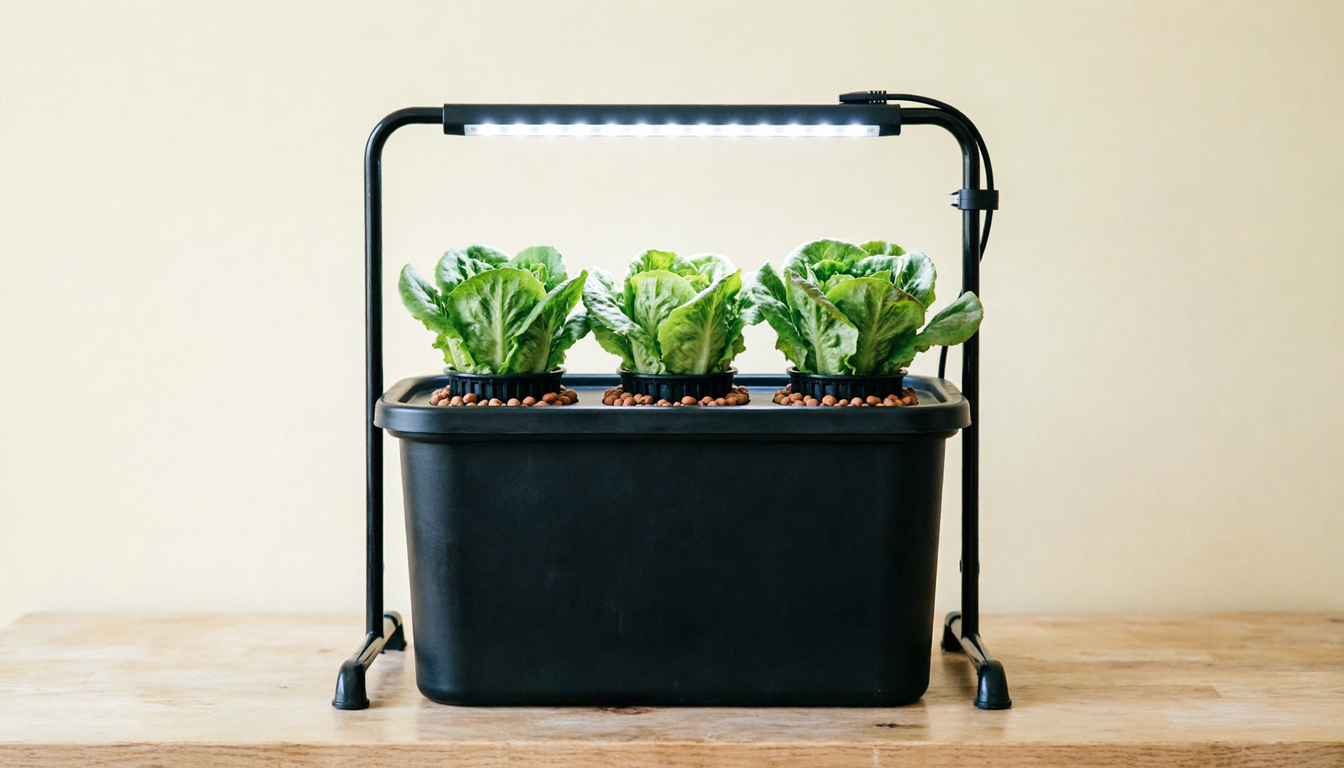
Indoor hydroponics can save money when you keep the equipment cheap, use the harvest and stop buying the food it replaces. A small grocery bill leaves very little room for equipment, refills and failed crops. Start with that bill before choosing a garden.
For a household buying half a pound of comparable greens each week at an assumed $4 per pound, the annual spending ceiling is $104. The example annual running costs below are $85.59 for a reused-bucket setup, $100.59 for a small countertop unit and $309.10 for a premium tower, before unquoted delivery and tax. Even replacing every eligible purchase would leave little toward the two smaller setups and would not cover the tower’s running cost.
To justify a purchase through grocery savings, the food you use instead of purchases has to cover the growing costs. The tables show that threshold and cap the credit at your ordinary shopping bill.
Count the purchases you can stop making
Use the price of the same food you ordinarily buy. Compare trimmed lettuce with lettuce, and usable basil leaves with basil. Do not value a bowl of mixed greens at the price of a tiny herb packet. A cheap head of store lettuce may be harder to beat than a premium salad bag, especially if you already use the whole head.
Weigh what reaches your meals after trimming and spoilage. Keep gifts, discarded leaves and extra vegetables you eat beyond your normal purchases out of grocery savings. Extra food can be welcome without reducing spending.
The calculation for each crop is:
Avoided grocery spending = the smaller of usable replacement harvest and ordinary purchases × the comparable grocery price.
Apply that cap over the weeks when you actually use the food. A large harvest in one week does not cancel purchases months later unless you preserve and eventually use it in place of those purchases.
An expensive herb price can be misleading. If your own shopping pattern is one $2 half-ounce packet every other week, the annual bill you can eliminate is only $52. Apply that price to those 13 ounces of herbs, not to pounds of lettuce. These grocery prices are inputs for the examples, not local store quotes; put your receipts beside the table before deciding.
Three setups, with room to tend them
University of Minnesota Extension recommends leafy greens and herbs for small hydroponic systems. It warns that the added heat and light needed for indoor tomatoes, cucumbers and strawberries can be cost-prohibitive for most gardeners. Start this savings comparison with greens you already eat.[1]
Reuse a bucket and buy only the missing parts
The DIY example is one clean, opaque, food-safe 5-gallon bucket with a fitted lid, one net pot and a suitable hydroponic starter plug, holding one lettuce plant. Add a securely supported SANSI PAR25 15W bulb in a compatible US E26 fixture, a timer, hydroponic nutrients and a pH test kit. Borrow the drill and hole cutter; reuse a sound spill tray and harvesting scissors. This is a single-plant trial, not a claim that one bucket supplies a weekly salad.
Minnesota Extension identifies a 5-gallon bucket as a suitable simple reservoir and describes passive aeration through the air gap. Its guidance is to keep only about one-third to one-half of the developed roots submerged. Leave the air gap when adding solution; filling to the lid can deprive roots of oxygen.[1]
SANSI’s selected US E26, one-bulb offer was $19.99 on October 15, 2026. It lists a 15W rating and a PPFD of 152.83 micromoles per square meter per second at one foot. That point reading does not establish uniform light over a shelf of plants.[2] The budget uses one bulb for one plant, with the light initially positioned using the maker’s guidance and adjusted to the crop.
For planning, reserve an 18-by-18-inch area that can contain your actual bucket and canopy. Leave another 24 inches in front for tending if that suits your reach and water container. That example occupies 5.25 square feet including access; it is a proposed layout, not a measured bucket footprint or a required safety clearance. Height must accommodate the measured bucket, mature foliage, lamp-to-leaf distance and fixture. Keep the route to the sink clear.
A small countertop unit: LetPot Mini
The selected black, US-adapter LetPot Mini showed $56.99 on October 15. Its listing gives a roughly 0.4-gallon (1.5-liter) tank, a base 8.7 inches wide by 5.3 inches deep and a maximum overall height of 16.3 inches. The roughly 0.32-square-foot base is only the appliance outline.[3]
The linked LPH-M5W manual calls for plants that fit beneath a light panel about 11.8 inches (300 mm) high. It includes five sponges and baskets, plus one 50 ml bottle each of A and B nutrient concentrate after preparation.[4] Five openings do not establish room for five mature lettuces. Start sparsely, cover unused openings and check foliage clearance before filling the remaining baskets.
Keep space above the unit to raise the lamp and remove plants, and beside it to lift the lid and pour water. Do those movements with the empty unit before fitting it beneath a kitchen cabinet. The replacement sponge budget below is a reader-entered allowance for the correct Mini parts; do not assume a pack for another LetPot model will fit.
A premium benchmark: Gardyn Studio 2
Gardyn Studio 2 lists at $549, with dimensions of 17 inches wide by 12 inches deep by 54 inches high. Its approximately 1.4-square-foot base excludes mature leaves and working space. The package includes a 16-plant starter set and plant food.[6]
The example uses the Studio without membership and buys replacement plants separately. Gardyn permits that choice.[6] Leave room to reach the planting pockets, open and clean the tank, and move water between the garden and sink. Use Studio instructions for assembly and restraint; our Gardyn Home 4 setup guide covers a different model and must not supply the Studio’s dimensions or assembly sequence.
This tower is a cost benchmark, not an equivalent-output substitute for the bucket. Its larger structure does not tell us how much of your grocery bill it will replace.
Put every cash cost in the budget
These US-dollar examples combine October 15, 2026 device and supply prices with clearly marked shopping allowances. Gardyn membership and nonmember shipping terms were checked October 11. The budgets exclude sales tax and unquoted delivery. Gardyn replacement-order shipping is included. No coupon, membership discount or financing saving is applied. LetPot’s storefront advertises free shipping over $29 but warns that some US-bound accessories may incur shipping charges, so check the actual order.[3]
An allowance means an assumed amount actually spent in the example. Money merely kept in a repair fund is not a cash expense. Replace each allowance with your own quote or purchase record.
Scroll sideways to compare columns. Keyboard users can focus the table and use the Left and Right arrow keys.
| Initial setup, before growing supplies bought during the year | DIY bucket | LetPot Mini | Gardyn Studio 2 |
|---|---|---|---|
| Selected lamp or complete device | $19.99[2] | $56.99[3] | $549.00[6] |
| Suitable fixture and timer, assumed purchase | $25.00 | Included device controls | Included device controls |
| Net pot, lid adaptation and initial medium, assumed purchase | $10.00 | Included starter baskets/sponges[4] | Included starter planting[6] |
| pH testing equipment, assumed purchase | $15.00 | $15.00 | $15.00 |
| Existing safe bucket, tray and tools | $0 new spending | $0 new spending | $0 new spending |
| Setup total | $69.99 | $71.99 | $564.00 |
If you do not already own the specified safe items, add them. Buying a shelf, new tools or an attractive enclosure can remove the reason to choose the cheap bucket. If you already own the lamp, fixture, timer and net-pot assembly, this example’s new setup outlay falls to $15 for the testing equipment.
Nutrients need a dose and a purchase quantity
LetPot’s $16.99 refill pack contains two 100 ml bottles of A and two 100 ml bottles of B. After preparing the concentrates, the label calls for 5 ml of A and 5 ml of B per liter of water; its Mini row specifies 7.5 ml of each for 1.5 liters.[5] A complete refill pack therefore makes 40 liters at that dose. Follow the mixing order and crop instructions; this is not a recipe for a different nutrient brand.
The DIY and Mini budgets each assume about 21.1 gallons (80 liters) of nutrient solution prepared during the year, including initial fills, replacements and top-ups. This is an input to change after keeping a water log. For the Mini, 26 complete 1.5-liter changes would account for 39 liters, leaving 41 liters of top-ups in this particular budget. The manual suggests changing or replenishing every two weeks; it does not predict those top-ups.[4]
Both examples buy two complete refill packs for $33.98. The Mini’s included A/B bottles supply another 10 liters’ worth, so its first year ends with 10 liters’ worth of unused concentrate under these inputs. The manual gives dissolved nutrients a five-month storage period.[4] This conservative cash example assumes that opened remainder has expired before the next budget year. Keep usable stock and reduce the next order when the actual dates allow it.
For Gardyn, the nonmember price is $19.99 per 8-ounce plant-food bottle. Gardyn estimates that one bottle lasts about three to six months.[8] The budget buys two bottles per year and gives no cash credit for an unspecified quantity of food included with the device. If your use calls for four purchased bottles, add $39.98. Follow Gardyn’s feeding stages: its care guide starts both Studio and Home with 3 gallons of water and no plant food during initial germination.[9]
Light schedules and pump schedules are different inputs
Use the marginal price per kWh from your electricity bill. The example tariff is $0.20/kWh, not a claimed national or local rate.
- The DIY bulb runs at its rated 15W for an assumed 16 hours daily. Over 365 days that is 87.6 kWh, or $17.52. The passive bucket has no pump and no pump electricity.
- The Mini’s documented rating is 10W. Its manual describes 12/24-hour pump modes but does not separate lamp, pump and standby wattage.[3][4] For budgeting, the table charges the entire 10W rating for 24 hours daily: 87.6 kWh and $17.52. This is a deliberately conservative rated-power scenario, not a wall-meter result or an instruction to leave the light on continuously. Set the crop’s light schedule separately; the scenario uses 16 hours of light and the longer pump mode. Meter the complete appliance, including adapter losses, to replace this estimate.
- Studio 2 lists one 52W light and estimated complete-device use of 26 kWh per month.[6] The table uses that whole-device estimate: 312 kWh and $62.40 per year. Gardyn recommends 14–16 continuous hours at its Boost light setting and says a manually started watering cycle stops after 15 minutes.[7] Actual pump frequency changes with the schedule. Do not add another lamp or pump estimate on top of the 26 kWh figure.
For a component calculation, use watts × hours per day × days ÷ 1,000 × tariff. A hypothetical 5W pump running three 15-minute cycles daily would cost $0.27 per year at this tariff. That is a demonstration of duty-cycle arithmetic, not a Gardyn pump specification or a watering recommendation.
Keep room heating, cooling and an extra fan on separate lines. The budget assumes no extra climate-control spending. An added 5W fan left on continuously would add $8.76 per year at the example tariff.
Annual purchases, including upkeep
The seed line buys one small Botanical Interests Salad Bowl Blend packet at $3.49 each year; the selected packet is approximately 0.75 g, not the larger packet described elsewhere on its page.[10] Keep viable leftover seeds rather than buying another packet simply to follow this table. The seed seller’s 8-inch thinning distance is also a useful warning against crowding every opening in a small device, though it is not a hydroponic yield result.[10]
Scroll sideways to compare columns. Keyboard users can focus the table and use the Left and Right arrow keys.
| Recurring cash paid during each example year | DIY bucket | LetPot Mini | Gardyn Studio 2 |
|---|---|---|---|
| Seed packet or 24 paid replacement yCubes | $3.49 | $3.49 | $119.76 |
| Nutrients: whole packs/bottles described above | $33.98 | $33.98 | $39.98 |
| Additional growing medium/sponges, assumed purchase | $10.00 | $20.00 | Included in purchased yCubes |
| pH consumables, assumed purchase | $5.00 | $5.00 | $5.00 |
| Cleaning supplies, assumed purchase | $5.00 | $5.00 | $15.00 |
| Replacement parts actually bought, assumed expense | $10.00 | $15.00 | $25.00 |
| Water, including cleaning | $0.60 | $0.60 | $2.00 |
| Electricity under the stated schedules | $17.52 | $17.52 | $62.40 |
| Four nonmember replacement-supply deliveries | Unquoted; excluded | Unquoted; excluded | $39.96 |
| Recurring total before excluded charges | $85.59 | $100.59 | $309.10 |
| First-year setup plus recurring cash | $155.58 | $172.58 | $873.10 |
The water assumption is about 31.7 gallons (120 liters) for each smaller setup and 105.7 gallons (400 liters) for Studio, at an illustrative combined variable water/sewer rate of $0.005 per liter. These volumes include cleaning and discarded solution; they are not measured plant demand. Buying filtered water could change this line substantially.
The Gardyn supply line assumes 24 purchased replacement yCubes at the listed starting price of $4.99, delivered in four orders at $9.99 each.[11] Those purchases are additional to the included starter planting in year one; later years use the stated paid replacements. They do not establish an annual planting cycle or output. Price the actual varieties, nutrient deliveries and extras in your cart. The example assumes the two food bottles travel with those orders.
Membership remains $0 here. If you choose it, replace the relevant supply and shipping lines with the plan’s actual payments and redemptions rather than adding its fee while still charging every covered item. Our indoor garden yearly-cost guide explains whole-pack purchases and prepaid plans in more detail. Studio’s listed one-year prepaid plan costs $259 up front.[12]
Required harvest for cash break-even
For the fixed annual shopping budgets above:
First-year break-even pounds = (setup + recurring cash) ÷ grocery price per pound.
These are required quantities of comparable food actually used instead of purchases. They are not predicted harvests. If meeting the target requires more starts, nutrients or electricity than the budget includes, raise the cost and recalculate.
Scroll sideways to compare columns. Keyboard users can focus the table and use the Left and Right arrow keys.
| Required first-year replacement harvest | At a reader-entered $2/lb | At $4/lb | At $8/lb |
|---|---|---|---|
| DIY bucket | 77.79 lb | 38.90 lb | 19.45 lb |
| LetPot Mini | 86.29 lb | 43.15 lb | 21.57 lb |
| Gardyn Studio 2 | 436.55 lb | 218.28 lb | 109.14 lb |
At $4/lb, later-year operation alone needs 21.40 lb from the bucket example, 25.15 lb from the Mini or 77.28 lb from Studio. Keeping equipment you already own removes its old purchase price from the next year’s cash decision, but it does not remove these running costs.
A one-plant bucket has no established ability to meet even the lower targets here. If reaching the threshold would require several buckets and lamps, price that larger installation instead. For the Mini, five baskets are no evidence that 43.15 pounds of first-year replacement harvest is attainable.
If you model a separate variable growing cost per pound, subtract it from the grocery price before dividing. When that variable cost equals or exceeds the grocery price, additional harvest cannot cover the fixed costs. Do not subtract it again if it is already in the annual budget.
First-year cash, later-year cash and ROI
Suppose your household ordinarily buys half a pound of these greens each week. Allow six initial weeks with no replacement harvest, leaving a first-year cap of 23 pounds and a later-year cap of 26 pounds. Six weeks is a planning input, not a promised first harvest for any of these setups.
The table gives each system the benefit of replacing every purchase within those caps. It is therefore a spending-limit test, not an output forecast. Matching the annual weight also requires usable food at the right times.
Scroll sideways to compare columns. Keyboard users can focus the table and use the Left and Right arrow keys.
| Grocery-price scenario | DIY: first year / later year | Mini: first year / later year | Studio: first year / later year |
|---|---|---|---|
| Lower-price food: $2/lb | −$109.58 / −$33.59 | −$126.58 / −$48.59 | −$827.10 / −$257.10 |
| Middle price: $4/lb | −$63.58 / +$18.41 | −$80.58 / +$3.41 | −$781.10 / −$205.10 |
| Higher-price food: $8/lb | +$28.42 / +$122.41 | +$11.42 / +$107.41 | −$689.10 / −$101.10 |
At $2/lb, all three lose cash even after the initial equipment purchase. At $4/lb, the small positive later-year results depend on filling the entire cap; neither smaller setup recovers its initial cost within the three-year calculation. Studio has no cash payback in any of these capped examples because its running cost exceeds the avoided purchases.
At $8/lb, the arithmetic permits the two smaller setups to recover their costs by the end of year one, only if they really deliver the stated 23 pounds of replacement food within that year’s shopping budget. Check actual harvest records before relying on that outcome. A larger grocery bill raises the spending ceiling without increasing what a particular unit can grow.
For this comparison, cash ROI means:
100 × (cumulative avoided purchases − setup − recurring spending) ÷ (setup + recurring spending).
The denominator is all cash paid over the stated horizon, not just the device price. Under the $4/lb capped example, first-year ROI is −40.9% for DIY, −46.7% for Mini and −89.5% for Studio. Over three years, with unchanged running budgets and continued operation, it is −8.2%, −19.7% and −79.9%. Tax or additional delivery would lower those results. Setup is paid once; the calculation does not subtract depreciation again.
Simple payback divides setup cost by a positive, stable annual operating saving. Establishment time makes this example uneven, so use its cumulative yearly results instead of promising a payback month. There is no payback when operating saving is zero or negative, and no reason to project a tiny positive saving indefinitely beyond the equipment’s usable life.
Failed starts and time can erase a narrow saving
If usable replacement falls to half the later-year cap at $4/lb, avoided spending falls to $52. The annual cash results become −$33.59 for DIY, −$48.59 for Mini and −$257.10 for Studio, even before another seed or part purchase.
A separate failure example loses six more weeks of the half-pound weekly replacement and spends $10 on extra starter supplies. At $4/lb that worsens the year by $22. For Studio, six extra $4.99 replacement cubes plus one $9.99 delivery and the same lost purchases worsen it by $51.93. A grow guarantee may replace an eligible unsprouted cube, but it does not refund electricity or replace missed groceries. Check eligibility before budgeting a free replacement.[6]
Electricity can matter when the margin is small. At $0.40/kWh rather than $0.20, the annual electricity line rises from $17.52 to $35.04 for either small setup and from $62.40 to $124.80 for Studio. Every additional $10 of cost requires another 2.5 pounds of replacement greens at $4/lb.
Count labor separately. At an assumed 15 minutes a week, tending takes 13 hours a year. Valuing that time at $15 an hour adds $195 to the comparison. This is a sensitivity input, not a measured maintenance time. Include seeding, thinning, root checks, cleaning and harvesting in your own log. You may be happy to spend that time gardening even when it does not save money.
Keep the food and the household safe
Use a clean, food-safe reservoir and clean water. Minnesota Extension warns that warm nutrient solution can support pathogens, recommends handwashing and clean harvesting tools, and advises cleaning and sanitizing equipment between plantings. Rinse harvested produce thoroughly before eating it.[1] Follow the sanitizer’s label for concentration, contact time, rinsing and protective equipment; do not combine cleaning chemicals.
Keep concentrates away from children and pets. LetPot’s nutrient label says not to ingest them and to avoid eye contact.[5] Minnesota’s general hydroponic guidance gives a pH range of 5.4–7, while also advising crop-specific nutrient choices.[1] Check your crop and product instructions rather than assuming more fertilizer improves growth.
Keep electrical connections dry and use equipment in its intended setting. Studio specifies a grounded power supply.[6] A borrowed fixture must be suitable for the bulb and securely supported. Do not put an improvised lamp where a refill can splash it.
Growing greens within reach can make it convenient to pick what you will cook. It does not establish that the food is more nutritious, pesticide-free or safer than store produce. Hydroponic plants can still have pests and disease.[1] Buying inexpensive fresh or frozen vegetables remains a valid choice; frozen vegetables for cooked meals need not be compared with the price of delicate salad leaves.
The cheapest sensible next step
Check what you already own and record the ordinary greens and herbs you buy. If that bill is below the running budget, skip a new appliance as a grocery-saving purchase.
For a first attempt, choose a setup you can afford even if the crop fails. A safe reused bucket avoids paying for a housing and pump. A bright windowsill may reduce lighting purchases, but Minnesota Extension says indoor supplemental light is almost always necessary, especially in winter.[1] Do not promise yourself free year-round production from summer window light.
Record actual edible harvest, purchases avoided, water, refills and electricity before expanding. Buy the next unit only when those records support its cost and you have room to tend it. If the numbers favor the grocery store, keep buying the food there.
Sources
- UMN Extension: small-scale hydroponics
- SANSI PAR25 15W, US E26 one-pack
- LetPot LPH-Mini, black US option
- LetPot LPH-M5W official user manual
- LetPot A/B nutrients, four-bottle pack
- Gardyn Studio 2 specifications and US price
- Gardyn light and water schedules
- Gardyn plant-food bottle pricing
- Gardyn care cycle
- Botanical Interests Salad Bowl Blend, small packet
- Gardyn nonmember plants and shipping
- Gardyn Studio exact optional plans


